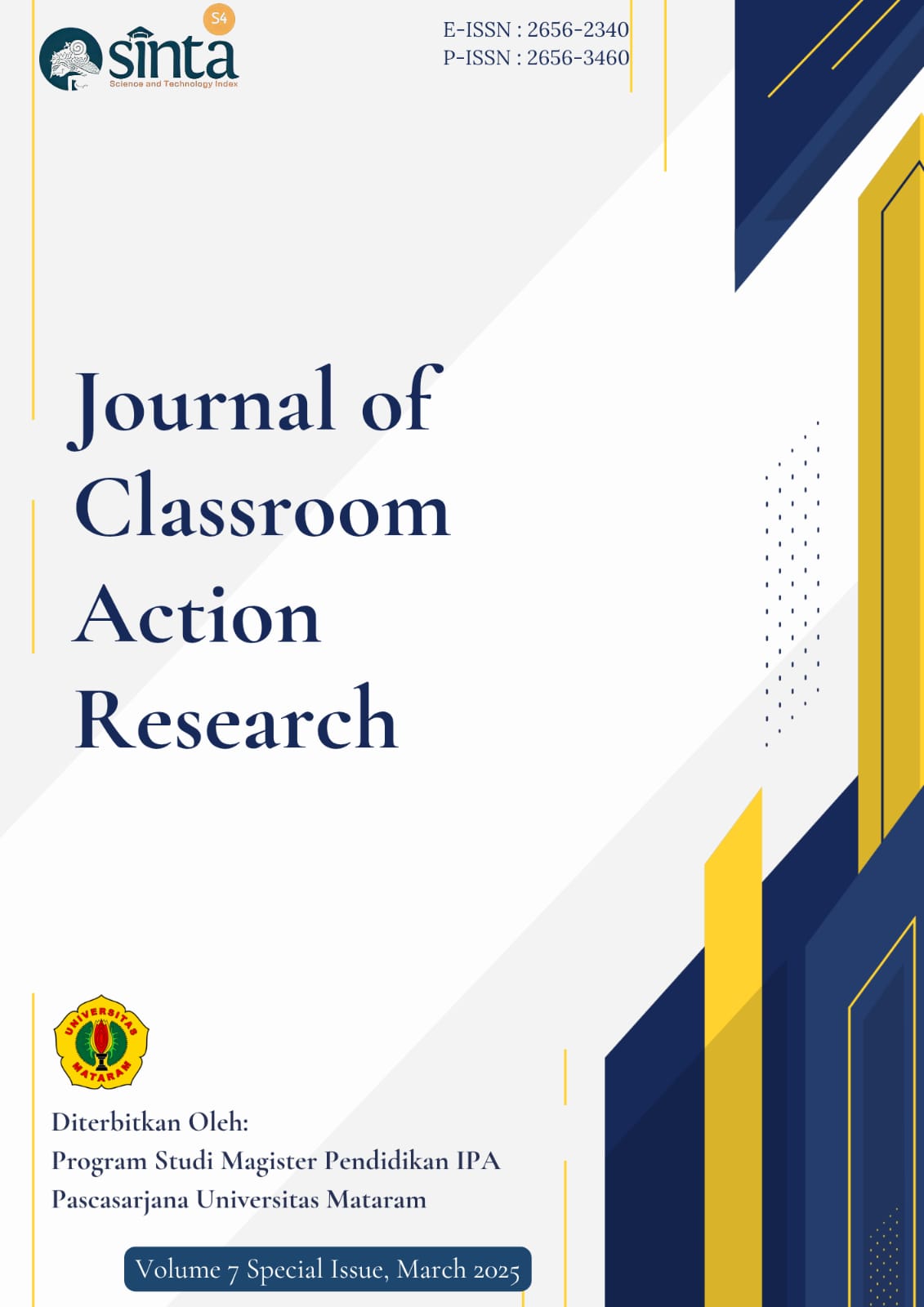
Improving Students’ Speaking Skills Through Alice in Wonderland Movie for Eleventh-Grade Students of MAS Maftahul Falah Sekacer Academic Year 2023/3024
DOI:
10.29303/jcar.v7iSpecialIssue.10665Published:
2025-04-23Downloads
Abstract
The purpose of this study is to decide whether or not watching films helps students improve their speaking abilities. This research focused on how English movies' effects are applied to learning. Researchers used pre-experimental research, which included just one class in the study. MAS Maftahul Falah, who was in eleventh grade, was the population of this research. The researcher selected the sample using saturation sampling. The 18 students are the subject of the research in the academic year 2023/2024 to participate in a project to observe how their speaking ability develops. Testing of the instruments was conducted during the data collection process, before and after the treatment. The result showed that the mean score of the post-test was higher than score of the pre-test (72.50 > 61.33). This indicated that there was a significant effect on post-test results. Then, the result of the hypothesis analysis showed that the 2-tailed sig value was lower than alpha (0.000 < 0.05). This means that H0 is rejected and Ha is accepted. From these results, there were significant effects of the use of Alice in Wonderland movie as teaching media on students’ speaking skills.
Keywords:
Speaking Skills Alice in Wonderland Movie Pre-Experimental ResearchReferences
Asmari, A. A. Al. (2015). Communicative language teaching in efl university context: Challenges for teachers. Journal of Language Teaching and Research, 6(5), 976–984. https://doi.org/10.17507/jltr.0605.09
Butler, J. (2020). The visual experience of accessing captioned television and digital videos. Television & New Media, 21(7), 679-696.
Fitria, S. E., & Ariva, V. F. (2019). Analisis Faktor Kondisi Ekonomi, Tingkat Pendidikan Dan Kemampuan Berwirausaha Terhadap Kinerja Usaha Bagi Pengusaha Pindang Di Desa Cukanggenteng. Jurnal Manajemen Indonesia, 18(3), 197–208.
Hariati, P. (2022). Improving Students’ Speaking Skill Through English Movie. Language Literacy: Journal of Linguistics, Literature, and Language Teaching, 6(2), 454–461. https://doi.org/10.30743/ll.v6i2.6176
Kabooha, R. H. (2016). Using Movies in EFL Classrooms: A Study Conducted at the English Language Institute (ELI), King Abdul-Aziz University. English Language Teaching, 9(3), 248. https://doi.org/10.5539/elt.v9n3p248
Kinasih, P. R., & Olivia, O. (2022). An Analysis of Using Movies to Enhance Students’ Public Speaking Skills in Online Class. Journal of Languages and Language Teaching, 10(3), 315. https://doi.org/10.33394/jollt.v10i3.5435
Prajapati, R. K., Sharma, B., & Sharma, D. (2017). Significance of life skills education. Contemporary Issues in Education Research, 10(1), 1-6.
Raruoalli Srinivas Rao. (2019). The Importance of Speaking Skills in English Classrooms. Alford Council of International English & Literature Journal(ACIELJ), Vol 2(Issue 2), 14. www.acielj.com
Ravilovich, K. R., Gabdulbarovna, M. F., Fakhrutdinova, A. V., Mikhailovich, S. A., Lvovna, P. O., & Igorevna, L. I. (2023). The Effect of the Educational Environment on the Mental, Intellectual, Psychological and Social Development of English Language Teaching Students. Applied Linguistics (ICRAL).
Renandya, W. A., & Nguyen, M. T. T. (2022). Teaching speaking in L2 contexts. In Handbook of practical second language teaching and learning (pp. 269-280). Routledge.
Ruman, M. A. K. (2021). Challenges of teaching English listening, speaking, reading and writing skills at Qawmi Madrasas under BEFAQ in Bangladesh. International Journal of Linguistics, Literature and Translation, 4(7), 125-138.
Saefullah, M., Fauzan, A., Syam, U. K., & Daddi, H. (2018). IMPROVING STUDENT ’ S SPEAKING ABILITY THROUGH MOBILE SOCIAL NETWORKING : A Pre-Experimental Research. Journal of Computer Interaction in Education, 1(2), 151–160.
Safitri, N., Lutfi, & Rohana. (2023). The Effect of Apply Audio Visual Media To The IV Grades Student Learning Outcomes To Citizenship Education Subject. Excellent Education, Science and Engineering Advances Journal, 2(1), 49–55. https://ojs.nubinsmart.id/index.php/eeseaj/article/view/234
Thi, B., & Giang, K. (2020). STUDENTS ’ PERCEPTIONS TOWARDS USING ENGLISH MOVIES TO ENHANCE THEIR ENGLISH SPEAKING SKILLS C Ả M NH Ậ N C ỦA SINH VIÊN ĐỐ I V Ớ I VI ỆC XEM CÁC ĐOẠ N PHIM of researches relating to the use of watching English movies to enhance English speaking highlight. TNU Journal of Science and Technology, 225(12), 85–92.
Thi, N., & My, T. (2021). a Study on the Effects of Movie Viewing on Learning English To Develop Listening and Speaking Skills of Students At Hanoi University of Business and Technology. 15, 59–63.
License
Copyright (c) 2025 Olga Junior Widoretno, Aprilia Riyana Putri

This work is licensed under a Creative Commons Attribution 4.0 International License.
- Authors who publish with Journal of Classroom Action Research, agree to the following terms:
- Authors retain copyright and grant the journal right of first publication with the work simultaneously licensed under a Creative Commons Attribution 4.0 International License (CC-BY License). This license allows authors to use all articles, data sets, graphics, and appendices in data mining applications, search engines, web sites, blogs, and other platforms by providing an appropriate reference. The journal allows the author(s) to hold the copyright without restrictions and will retain publishing rights without restrictions.
- Authors are able to enter into separate, additional contractual arrangements for the non-exclusive distribution of the journal's published version of the work (e.g., post it to an institutional repository or publish it in a book), with an acknowledgment of its initial publication in Journal of Classroom Action Research.
- Authors are permitted and encouraged to post their work online (e.g., in institutional repositories or on their website) prior to and during the submission process, as it can lead to productive exchanges, as well as earlier and greater citation of published work (See The Effect of Open Access).