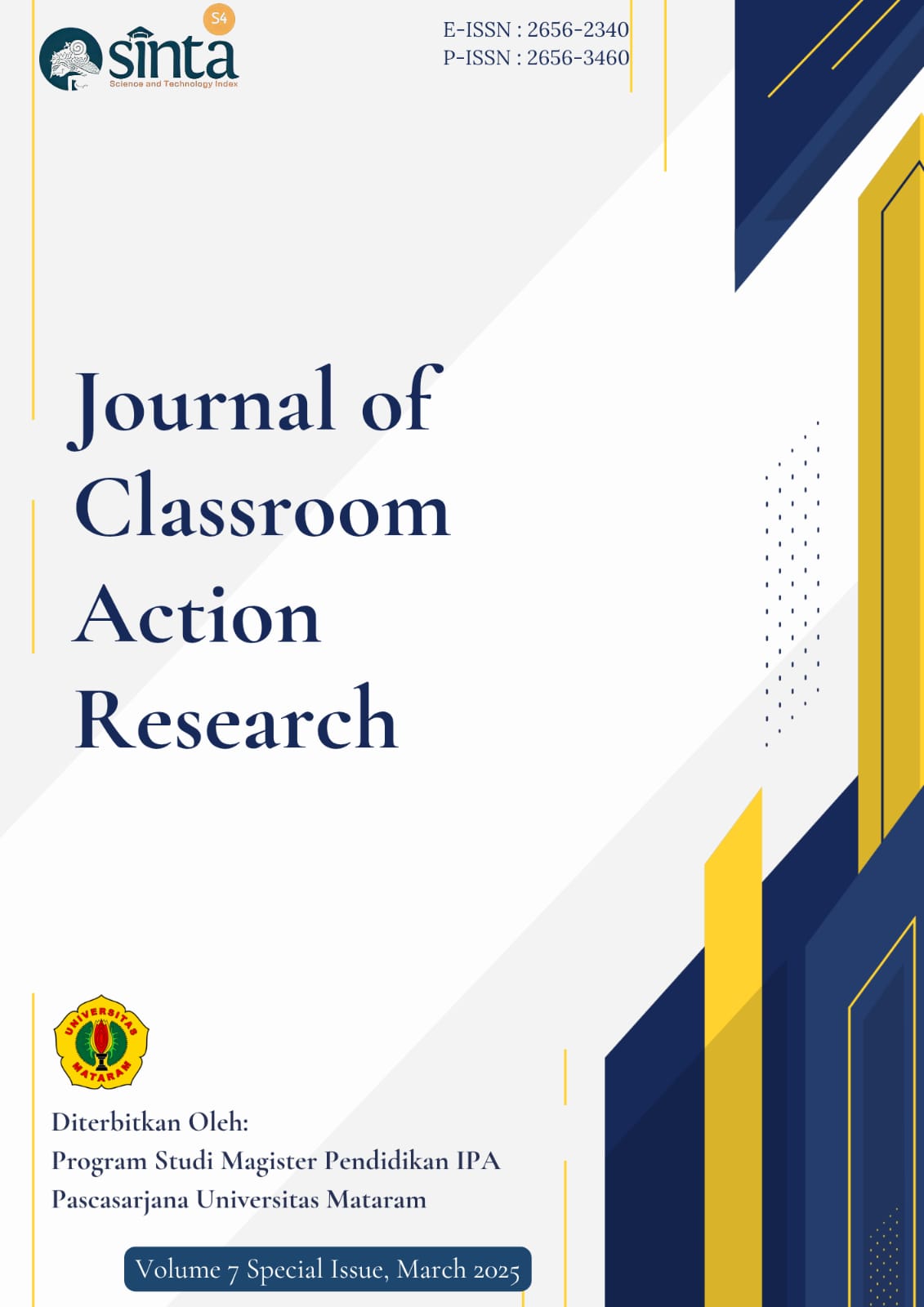
Students' Speaking Achievement at Seventh Grade Using Snowball Throwing Model: An Experimental Study
DOI:
10.29303/jcar.v7iSpecialIssue.11002Published:
2025-05-14Downloads
Abstract
Many students struggle with English fluency due to the use of traditional teaching methods that lack engagement and interactivity. This study aims to assess the impact of the Snowball Throwing model on pupils' speaking abilities at SMPN 34 Surabaya. A quantitative research approach was adopted, employing an experimental design that included both an experimental and a control group. Data collection followed a structured procedure, comprising a pre-test, the application of the treatment, and a post-test using procedure text material. This study used the cluster random sampling approach, which yielded a total sample of 58 pupils. Class VII-I was selected as the experimental group in this case, while Class VII-H was used as the control group. A speaking ability test served as the study tool, and IBM SPSS Statistics version 19 was used to analyze the data. The findings revealed a two-rooted p-value of 0.000, below the significance level of 0.05. Consequently, the null hypothesis (Ho) was rejected, and the alternative hypothesis (Ha) was validated, indicating that the Snowball Throwing model had a noteworthy effect on students' speaking abilities. It may be concluded that using the Snowball Throwing model influences students' speaking abilities because the p-value stayed below the significance threshold.
Keywords:
Learning Model Throwing Snowball Speaking AchievementReferences
Adinda, F., & Rahayu, E. M. (2023). The Effectiveness of U-Dictionary as Learning Media to Improve Students’ Vocabulary Achievement at Senior High School. Jurnal Pendidikan Bahasa Inggris Undiksha, 11(1), 10–17. https://doi.org/10.23887/jpbi.v11i1.60533
Alfatihah, A., Ismayanti, D., Syam, A. T., & Santaria, R. (2022). Teaching Speaking Skills through Project-Based Learning for the Eighth Graders of SMP Negeri 4 Palopo. IDEAS: Journal on English Language Teaching and Learning, Linguistics and Literature, 10(1), 152–165. https://doi.org/10.24256/ideas.v10i1.2555
Asrida, D. (2016). Communicative Activities Of Teaching Speaking For The Students. Ta’dib, 17(1), 60. https://doi.org/10.31958/jt.v17i1.259
Bayu, I. G. B. C., Piscayanti, K. S., & Paramartha, A. A. G. Y. (2018). The Effect Of “Storytelling Using Puppet” Strategy On Students’ Speaking Achievement At Eighth Grade Of Junior High School In Smp Negeri 1 Seririt. International Journal of Language and Literature, 2(3). https://doi.org/10.23887/ijll.v2i3.16318
Darmuki, A., Andayani, A., Nurkamto, J., & Saddhono, K. (2017). Evaluating Information-processing-based Learning Cooperative Model on Speaking Skill Course. Journal of Language Teaching and Research, 8(1), 44. https://doi.org/10.17507/jltr.0801.06
Firnanda, R., Gani, S. A., & Samad, I. A. (2019). The Influence Of Student Team- Achievement Division (Stad) In Developing Students’ Speaking Skill.
Fitriya, F., Nina Hayuningtyas, N., & Khodijah, S. (2022). Improving the Students’ Speaking Skill by Implementing Snowball Throwing Technique. CREW Journal, 1(1), 36–44. https://doi.org/10.35719/crewjournal.v1i1.1367
Hasanah, N. H., & Swondo, A. P. (2021). The Effect Of Snowball Throwing Method On Students’ Vocabulary Mastery. Journal MELT (Medium for English Language Teaching), 5(2), 175. https://doi.org/10.22303/melt.5.2.2020.175-185
Istiara, F., Hastomo, T., & Indriyanta, W. A. (2023). A Study of Students’ Engagement and Students’ Speaking Skill: A Correlational Research. TEKNOSASTIK, 21(1), 1. https://doi.org/10.33365/ts.v21i1.2198
Jumadi, P. L., Krismanto, W., & Ilmi, N. (2025). Big Book Integration in ARIAS Learning Model to Improve Elementary School Students’ Storytelling Ability. JCAR (Journal of Classroom Action Research), 7.
Kusuma, D. D., & Rahayu, E. M. (2024). The Implementation of Using Numbered Head Together (NHT) Learning Model to Improve Students’ Speaking Achievement. Edunesia : Jurnal Ilmiah Pendidikan, 5(2), 827–847. https://doi.org/10.51276/edu.v5i2.906
Lukman, L. (2024). Development of Contextual Learning Models to Improve Student’s Speaking Skills. Journal of Languages and Language Teaching, 12(1), 198. https://doi.org/10.33394/jollt.v12i1.9128
Ma’rifatun, F., Jannah, F., Rini, T. P. W., & Prihandoko, Y. (t.t.). V Increasing Student Activity And Creativity Using The. 01(02).
Meri Aryani. (2022). The Use of Rosetta Stone in Improving Speaking Skill. Journal of Teaching English and Applied Linguistic, 1(1), 35–42. https://doi.org/10.56517/jteal.v1i1.5
Muhria, L. (2021). Using Cooperative Lerning Model- Snowball Throw To Improve Students English Learning Outcomes. ELT Echo : The Journal of English Language Teaching in Foreign Language Context, 6(2). https://doi.org/10.24235/eltecho.v6i2.9226
Mukhibbah, T. L., & Rahayu, E. M. (2024). The Six Thinking Hats (STH) Strategy to Improve Students’ Speaking Achievement in Merdeka Curriculum. Jo-ELT (Journal of English Language Teaching) Fakultas Pendidikan Bahasa & Seni Prodi Pendidikan Bahasa Inggris IKIP, 11(1), 108. https://doi.org/10.33394/jo-elt.v11i1.11275
Muklas, M., Yuliana, R., Nurkhasanah, E., Fahriza, L. N., & Yulianda, S. Z. (2024). Analysis Of The Factors Affecting Students’ English Speaking Proficiency. Wiralodra English Journal, 8(1), 154–164. https://doi.org/10.31943/wej.v8i1.275
Oktaviani, K., Siminto, S., & Widiastuty, H. (2023). Implementation of Modified Total Physical Response (TPR) Learning Model to Improve Students Learning Achievement in English Speaking. EDUKASIA: Jurnal Pendidikan Dan Pembelajaran, 4(2), 2159–2168. https://doi.org/10.62775/edukasia.v4i2.563
Salim, D. P., Saini, F., & Paputungan, F. (2020). Improving Students’ Speaking Skill through Snowball Throwing Technique (STT) at Indonesian Junior High School. IDEAS: Journal on English Language Teaching and Learning, Linguistics and Literature, 8(1). https://doi.org/10.24256/ideas.v8i1.1321
Shafwati, D., Nurdiana, N., & Prakoso, G. H. (2022). Increasing Students’ Speaking Achievement Through Animation Movie: Universitas Lampung International Conference on Social Sciences (ULICoSS 2021), Bandar Lampung, Indonesia. https://doi.org/10.2991/assehr.k.220102.048
Syafryadin, S. (2020). The Effect of Talking Chips Technique Toward the Improvement of Students’ Speaking Achievement at one of the Senior High Schools in Bandung. Linguists : Journal Of Linguistics and Language Teaching, 6(2), 1. https://doi.org/10.29300/ling.v6i2.2776
Tini Mogea. (2023). Developing Students’ Speaking Ability through Snowball Throwing Technique. Journal of Creative Student Research, 1(2), 152–170. https://doi.org/10.55606/jcsrpolitama.v1i2.1201
Wianto, T., & Firdaus, M. (2025). Snowball Throwing Method to Increase Students’ Reading Comprehension and Learning Interest. JCAR (Journal of Classroom Action Research), 7.
Widoretno, O. J., & Putri, A. R. (2025). Improving Students’ Speaking Skills Through Alice in Wonderland Movie for Eleventh-Grade Students of MAS Maftahul Falah Sekacer Academic Year. JCAR (Journal of Classroom Action Research), 7.
Williana, D., Anugrah, W. P., & Kareviati, E. (2020). Improving English Speaking Ability Using The Snowball Throwing Games Technique. PROJECT (Professional Journal of English Education), 3(1), 43. https://doi.org/10.22460/project.v3i1.p43-48
Yusmi, Y., Su‘ad, S., & Murtono, M. (2021). The Effect Of Role Playing And Snowball Throwing Learning Model On Students’ Speaking Skill At Grade Iii Elementary School In Gugus Ra Kartini. JURNAL PAJAR (Pendidikan dan Pengajaran), 5(5), 1377. https://doi.org/10.33578/pjr.v5i5.8164
License
Copyright (c) 2025 Ailia Anggi Diajeng Yuliyanti, Endang Mastuti Rahayu

This work is licensed under a Creative Commons Attribution 4.0 International License.
- Authors who publish with Journal of Classroom Action Research, agree to the following terms:
- Authors retain copyright and grant the journal right of first publication with the work simultaneously licensed under a Creative Commons Attribution 4.0 International License (CC-BY License). This license allows authors to use all articles, data sets, graphics, and appendices in data mining applications, search engines, web sites, blogs, and other platforms by providing an appropriate reference. The journal allows the author(s) to hold the copyright without restrictions and will retain publishing rights without restrictions.
- Authors are able to enter into separate, additional contractual arrangements for the non-exclusive distribution of the journal's published version of the work (e.g., post it to an institutional repository or publish it in a book), with an acknowledgment of its initial publication in Journal of Classroom Action Research.
- Authors are permitted and encouraged to post their work online (e.g., in institutional repositories or on their website) prior to and during the submission process, as it can lead to productive exchanges, as well as earlier and greater citation of published work (See The Effect of Open Access).