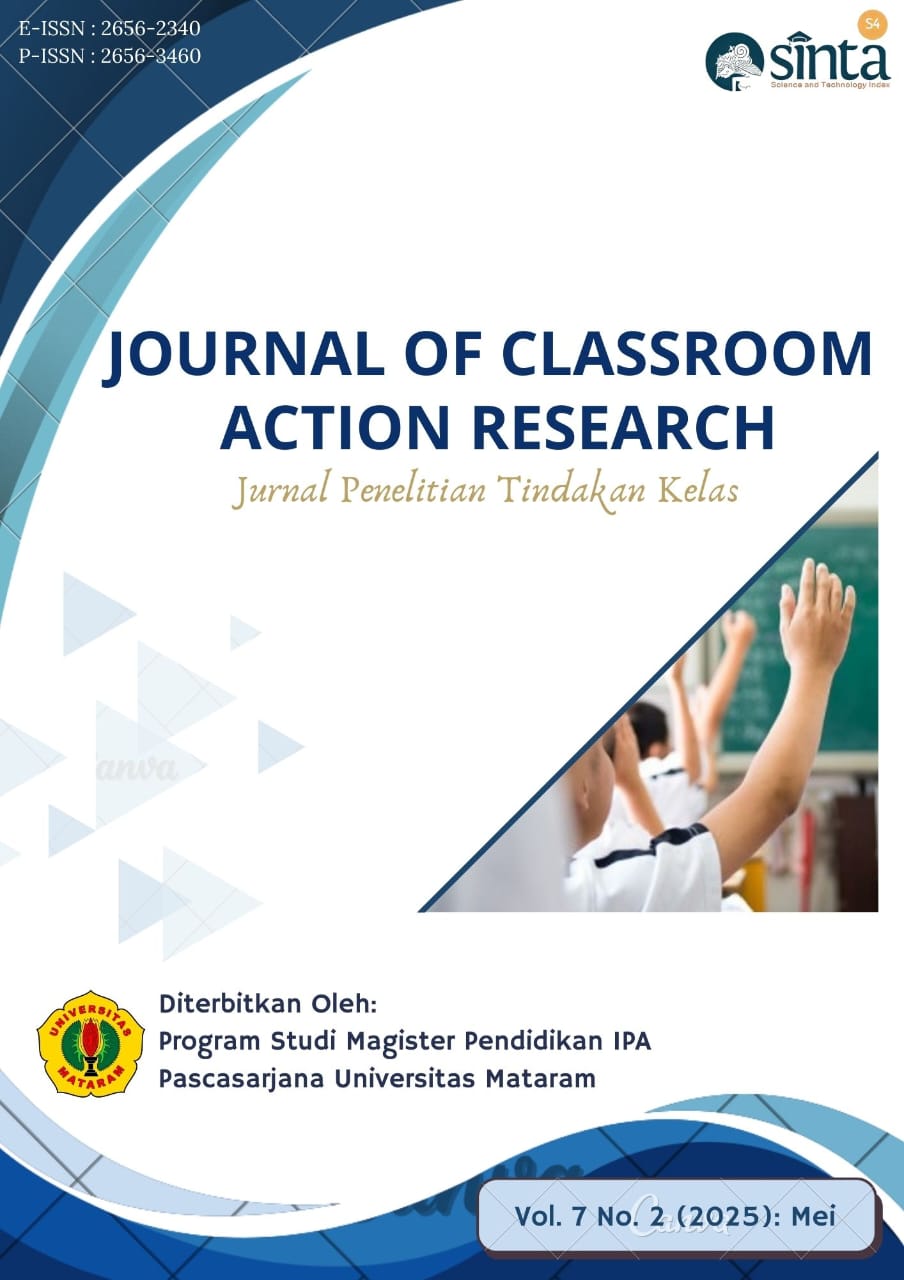
Model Cooperative Learning Berbasis Numerasi di Sekolah Setia Asih 01 Bekasi
DOI:
10.29303/jcar.v7i2.11054Published:
2025-05-30Downloads
Abstract
Numeracy-based Cooperative Learning is the basis for students in solving mathematical problems. Based on the results of initial observations conducted on students at SDN Setia Asih 01 Bekasi Regency, it was revealed that working on math problems is a problem, therefore a numeracy-based Cooperative Learning learning model is needed. Thus, the ability of numeracy-based Cooperative Learning can be used as an alternative solution to educational problems. This study aims to analyze the ability of numeracy-based Cooperative Learning of grade VI students through numeracy-based Cooperative Learning for students in elementary schools. The type of research used is The method used in this study is a mixed method of quantitative and qualitative methodology, with the design used in this study is The exploratory sequential design. Respondents in this study were 32 grade VI students. Data analysis in this study used descriptive and inferential statistics in the form of simple linear regression analysis. Based on the results of the study, it shows that the ability of numeracy-based Cooperative Learning can significantly improve their mathematics learning. Students' numeracy-based Cooperative Learning abilities are influenced by Cooperative Learning by 44.2%. Meanwhile, 55.8% was influenced by other factors outside of student numeracy-based cooperative learning.
Keywords:
Cooperative Learning Model; Numeracy; Elementary school studentsReferences
Al-Mamary, Y. H. S. (2022). Understanding the use of learning management systems by undergraduate university students using the UTAUT model: Credible evidence from Saudi Arabia. International Journal of Information Management Data Insights, 2(2). https://doi.org/10.1016/j.jjimei.2022.100092
Anwar, K., & Manurung, A. S. (2023). Pengaruh Motivasi Belajar Terhadap Hasil Belajar Matematika Dalam Pembelajaran Daring di MI Tarbiyatussa’adah. Edukatif : Jurnal Ilmu Pendidikan, 4(6), 8221–8230. https://doi.org/10.31004/edukatif.v4i6.3486
Aranzabal, A., Epelde, E., & Artetxe, M. (2022). Team formation on the basis of Belbin’s roles to enhance students’ performance in project based learning. Education for Chemical Engineers, 38(December 2020), 22–37. https://doi.org/10.1016/j.ece.2021.09.001
Arifin, Z., & Dkk. (2020). Metodologi penelitian pendidikan education research methodology. STIT Al-Hikmah Bumi Agung Way Kanan, 1, 3.
Boso, C. M., van der Merwe, A. S., & Gross, J. (2021). Students’ and educators’ experiences with instructional activities towards critical thinking skills acquisition in a nursing school. International Journal of Africa Nursing Sciences, 14, 100293. https://doi.org/10.1016/j.ijans.2021.100293
Dewida, R. M., Bongguk, H., & Ulung, N. (2023). Pelaksanaan Kegiatan Literasi dan Numerasi bagi Peserta Didik Kelas Tinggi Sekolah Dasar. Jurnal Serunai Administrasi Pendidikan, 12(2), 82–91. https://ejournal.stkipbudidaya.ac.id/index.php/jc/article/view/1005%0Ahttps://ejournal.stkipbudidaya.ac.id/index.php/jc/article/download/1005/608
Eva Oktaviana, C. B. Y. (2022). Tecnological Pedagogical Content Knowledge (TPACK) Dalam Pembelajaran Abad Ke-21. SHEs: Conference Series, 5(2), 1–23.
Fadlilah, C., & Siswono, T. Y. E. (2022). Kemampuan Berpikir Kreatif Siswa Asimilasi (Assimilating) Dan Konvergen (Converging) Dalam Memecahkan Masalah Numerasi. MATHEdunesa, 11(2), 548–561. https://doi.org/10.26740/mathedunesa.v11n2.p548-561
Fakhriyani, L., Subarinah, S., Novitasari, D., & Sridana, N. (2025). Analisis Kemampuan Numerasi Siswa SMP Pada Konten Geometri dan Pengukuran Ditinjau Dari Gaya Kognitif. Journal of Classroom Action Research, 8(1).
Habbah, E. S. M., & Husna, E. N. (2024). Strategi Guru Dalam Pengelolaan Kelas Yang Efektif Untuk Meningkatkan Motivasi Belajar Siswa. Journal of Pedagogi, 1(2), 1–8. https://doi.org/10.62872/vf2gr537
Insani, G. N., Dewi, D., & Furnamasari, Y. F. (2021). Integrasi Pendidikan Karakter dalam Pembelajaran Pendidikan Kewarganegaraan untuk Mengembangkan Karakter Siswa Sekolah Dasar. 5, 8153–8160.
Manurung, A. S., & Pappachan, P. (2025). The role of discovery learning in efforts to develop students’ critical thinking abilities. Journal of Education and Learning, 19(1), 46–53. https://doi.org/10.11591/edulearn.v19i1.21788
Mustadi, A., Zubaidah, E., & Sumardi, S. (2016). Peran Komite Sekolah Dalam Peningkatan Mutu Pembelajaran Di Sekolah Dasar. Jurnal Cakrawala Pendidikan, 35(3), 312–321. https://doi.org/10.21831/cp.v35i3.10578
Muthuprasad, T., Aiswarya, S., Aditya, K. S., & Jha, G. K. (2021). Students’ perception and preference for online education in India during COVID -19 pandemic. Social Sciences and Humanities Open, 3(1), 100101. https://doi.org/10.1016/j.ssaho.2020.100101
Nengrum, T. A., Pettasolong, N., & Nuriman, M. (2021). Kelebihan dan Kekurangan Pembelajaran Luring dan Daring dalam Pencapaian Kompetensi Dasar Kurikulum Bahasa Arab di Madrasah Ibtidaiyah 2 Kabupaten Gorontalo. Jurnal Pendidikan, 30(1), 1. https://doi.org/10.32585/jp.v30i1.1190
Octavia, L. S., & Savira, S. I. (2017). Gaya Kepemimpinan Kepala Sekolah dalam Upaya Meningkatkan Kinerja Guru dan Tenaga Kependidikan. Jurnal Dinamika Manajemen Pendidikan, 1(1), 7. https://doi.org/10.26740/jdmp.v1n1.p7-14
Oktaria, S., Soeprianto, H., & Triutami, T. W. (2025). Pengaruh Model Pembelajaran Kooperatif Tipe Think Talk Write ( TTW ) Terhadap Pemahaman Konsep Matematis Materi Lingkaran Siswa. Journal of Classroom Action Research, 7(1).
Ramdani, D., Susilo, H., Suhadi, & Sueb. (2022). The Effectiveness of Collaborative Learning on Critical Thinking, Creative Thinking, and Metacognitive Skill Ability: Meta-Analysis on Biological Learning. European Journal of Educational Research, 11(3), 1607–1628. https://doi.org/10.12973/eu-jer.11.3.1607
Safitri. D; Manurung. S. Alberth. (2020). Penggunaan Model Problem Based Learning untuk meningkatkan Hasil Belajar Siswa SDIT Denada. Jurnal Persada, 3(3), 158–166. https://doi.org/https://doi.org/10.37150/perseda.v3i3.987
Sartania, N., Sneddon, S., Boyle, J. G., McQuarrie, E., & de Koning, H. P. (2022). Increasing Collaborative Discussion in Case-Based Learning Improves Student Engagement and Knowledge Acquisition. Medical Science Educator, 32(5), 1055–1064. https://doi.org/10.1007/s40670-022-01614-w
Sri Rika Amriani, & Halifah, S. (2024). Pengaruh Model Pembelajaran Kolaboratif terhadap Kecerdasan Interpersonal Anak Usia Dini. PAUD Lectura: Jurnal Pendidikan Anak Usia Dini, 7(2), 24–37. https://doi.org/10.31849/paud-lectura.v7i2.19868
Subandowo, M. (2022). Teknologi Pendidikan di Era Society 5.0. Sagacious Jurnal Ilmiah Pendidikan Dan Sosial, 9(1), 24–35.
Sugandi, A. I., Sofyan, D., Maesaroh, S., Linda, L., & Sumarmo, U. (2021). Efektivitas Pendekatan Induktif Deduktif Berbantuan Geogebra Terhadap Peningkatan Kemampuan Berpikir Kreatif Siswa Pada Masa Pandemi. AKSIOMA: Jurnal Program Studi Pendidikan Matematika, 10(1), 367. https://doi.org/10.24127/ajpm.v10i1.3452
Sugiyono. (2021). Statistika untuk penelitian. Alfabeta.
Sulaiman, N. A. (2022). PENGARUH KEMAMPUAN BERPIKIR KRITIS SISWA TERHADAP HASIL BELAJAR PENDIDIKAN AGAMA ISLAM. F O N D A T I A: Jurnal Pendidikan Dasar, 6(September 2022), 649–660.
Sutikno, Y., Hosan, H., & Irawati, I. (2022). Peran Kepala Sekolah dalam Meningkatkan Mutu Pendidikan. Jurnal Maitreyawira, 3(1), 1–7. https://doi.org/10.69607/jm.v3i1.46
Taddio, A., Ilersich, A. N. T., Bucci, L., McMurtry, C. M., Gudzak, V., Ipp, M., Zita, T., Tharmarajah, S., & MacDonald, N. (2022). Letting kids play their CARDs (Comfort, Ask, Relax, Distract) to help cope with needle-related fear and pain: Results from user testing. Vaccine, 40(52), 7667–7675. https://doi.org/10.1016/j.vaccine.2022.09.035
Ulandari, L., Turmuzi, M., & Triutami, T. W. (2025). Analisis Kemampuan Pemecahan Masalah Siswa Dalam Menyelesaikan Soal Cerita Pada Materi Bentuk Aljabar Ditinjau Dari Gaya Kognitif Di Kelas VII Tahun Pelajaran 2023 / 2024. Journal of Classroom Action Research, 7(1).
Wamsler, C., Schäpke, N., Fraude, C., Stasiak, D., Bruhn, T., Lawrence, M., Schroeder, H., & Mundaca, L. (2020). Enabling new mindsets and transformative skills for negotiating and activating climate action: Lessons from UNFCCC conferences of the parties. Environmental Science and Policy, 112(July), 227–235. https://doi.org/10.1016/j.envsci.2020.06.005
License
Copyright (c) 2025 Alberth Manurung, Abdul Halim, Syurya Muhammad Nur

This work is licensed under a Creative Commons Attribution 4.0 International License.
- Authors who publish with Journal of Classroom Action Research, agree to the following terms:
- Authors retain copyright and grant the journal right of first publication with the work simultaneously licensed under a Creative Commons Attribution 4.0 International License (CC-BY License). This license allows authors to use all articles, data sets, graphics, and appendices in data mining applications, search engines, web sites, blogs, and other platforms by providing an appropriate reference. The journal allows the author(s) to hold the copyright without restrictions and will retain publishing rights without restrictions.
- Authors are able to enter into separate, additional contractual arrangements for the non-exclusive distribution of the journal's published version of the work (e.g., post it to an institutional repository or publish it in a book), with an acknowledgment of its initial publication in Journal of Classroom Action Research.
- Authors are permitted and encouraged to post their work online (e.g., in institutional repositories or on their website) prior to and during the submission process, as it can lead to productive exchanges, as well as earlier and greater citation of published work (See The Effect of Open Access).