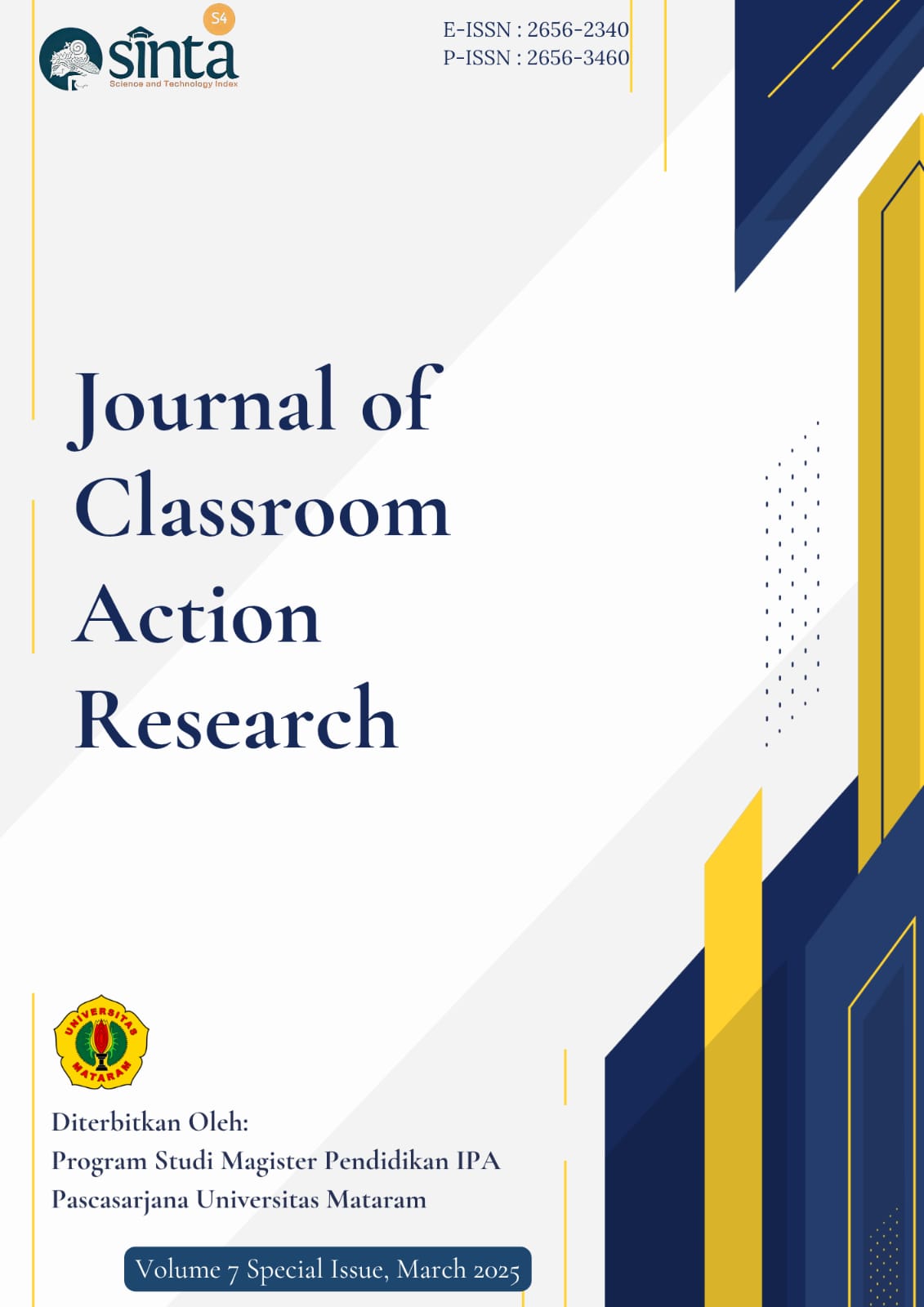
Analisis Kebutuhan Calon Guru SD/MI terhadap Workshop Pengembangan Media Pembelajaran Interaktif Berbasis Quizizz
DOI:
10.29303/jcar.v7iSpecialIssue.11331Published:
2025-03-31Downloads
Abstract
Perkembangan teknologi informasi telah membawa perubahan signifikan dalam dunia pendidikan, termasuk dalam penggunaan media pembelajaran interaktif. Tujuan dari penelitian ini adalah untuk mengidentifikasi kebutuhan pelatihan calon guru SD/MI terhadap penggunaan media pembelajaran interaktif berbasis Quizizz. Metode yang digunakan adalah deskriptif kuantitatif dengan penyebaran angket sebagai instrumen utama. Data yang diperoleh dari angket dianalisis secara deskriptif kuantitatif. Hasil angket yang disebarkan kepada 44 calon guru SD/MI menunjukkan bahwa meskipun sebagian besar dari mereka telah menggunakan media pembelajaran berbasis teknologi seperti PowerPoint, hanya sedikit yang memahami secara mendalam penggunaan aplikasi interaktif seperti Quizizz. Hasil penelitian juga menunjukkan bahwa 93,2% responden merasa perlu mengikuti workshop tentang penggunaan Quizizz, terutama dalam aspek membuat kuis interaktif, menganalisis hasil kuis, dan menciptakan pengalaman belajar yang menarik. Temuan ini menegaskan urgensi penyelenggaraan workshop sebagai langkah strategis untuk meningkatkan kompetensi calon guru dalam memanfaatkan teknologi sebagai media pembelajaran yang efektif dan menyenangkan di era digital saat ini.
Keywords:
Kata Kunci Analisis Kebutuhan Workshop Media Pembelajaran Interaktif QuizizzReferences
Adiyono, A., Hayat, E. W., Oktavia, E. D., & Prasetiyo, N. T. (2024). Learning interaction in the digital era: Technological innovations and education management strategies to enhance student engagement. Journal of Research in Instructional, 4(1), 205-221.
Akbar, J. S., & Djakaria, D. (2023). Pemanfaatan media pembelajaran berbasis android menggunakan pendekatan inkuiri untuk menguatkan technological pedagogical and content knowledge (TPACK) calon guru. Oxygenius: Journal Of Chemistry Education, 5(1), 46-53.
Aulia, R., Rasma, R., Kandias, S., Serli, S., Astiana, W., Witono, H., & Ibrahim, I. (2024). Analisis Kemampuan Membaca Kelas III SD Negeri 31 Mataram. Indonesian Journal of Elementary and Childhood Education, 5(1), 7-13.
Bahtiar, B., Maimun, M., Suranti, N. M. Y., Alimuddin, N., Wahyuningsih, B. Y., & Hasnawati, H. (2024). Pelatihan Penggunaan Phet Simulation Untuk Meningkatkan Keterampilan IPA Calon Guru SD Tahun 2024. Jurnal Interaktif: Warta Pengabdian Pendidikan, 4(1), 33-38.
Degirmenci, R. (2021). The use of Quizizz in language learning and teaching from the teachers' and students’ perspectives: A literature review. Language Education and Technology, 1(1), 1-11.
Dumitru, C., Radovici, M. C. M., Rasiti, G., & Veselinović, L. (2023). Science and learning in the digital era. Der Donauraum, 63(1-2), 83-98.
Dziubaniuk, O., Ivanova-Gongne, M., & Nyholm, M. (2023). Learning and teaching sustainable business in the digital era: a connectivism theory approach. International Journal of Educational Technology in Higher Education, 20(1), 20.
Fadhilawati, D. (2021). Using Quizizz application for learning and evaluating grammar material. JOSAR (Journal of Students Academic Research), 6(1), 64-73.
Hadisaputra, S., Gunawan, G., & Yustiqvar, M. (2019). Effects of green chemistry based interactive multimedia on the students' learning outcomes and scientific literacy. Journal of Advanced Research in Dynamical and Control Systems (JARDCS), 11(7), 664-674.
Ibrahim, I., Syazali, M., & Fauzi, A. (2024). Penerapan Project Based Learning Dalam Kurikulum Merdeka Untuk Mengembangkan Hardskill dan Softskill Peserta didik Sekolah Dasar: Literatur Review. PEDAGOGOS: Jurnal Pendidikan, 6(2), 53-60.
Junior, J. B. B. (2020). Assessment for learning with mobile apps: exploring the potential of quizizz in the educational context. International Journal of Development Research, 10(01), 33366-33371.
Lim, T. M., & Yunus, M. M. (2021). Teachers’ perception towards the use of Quizizz in the teaching and learning of English: A systematic review. Sustainability, 13(11), 6436.
Matzavela, V., & Alepis, E. (2021). M-learning in the COVID-19 era: physical vs digital class. Education and Information Technologies, 26(6), 7183-7203.
Muhazir, A., & Retnawati, H. (2020, March). The teachers’ obstacles in implementing technology in mathematics learning classes in the digital era. In Journal of physics: conference series (Vol. 1511, No. 1, p. 012022). IOP Publishing.
Munawir, A., & Hasbi, N. P. (2021). The Effect of Using Quizizz To Efl Students’engagement And Learning Outcome. English Review: Journal of English Education, 10(1), 297-308.
Nurwahidah, N., Suranti, N. M. Y., Ibrahim, I., & Alimuddin, N. (2024). In House Training Game Edukatif Berbasis Android Bagi Calon Guru SD Se-NTB. Indonesian Journal of Education and Community Services, 4(2), 80-88.
Pratomo, H., Sitompul, N. C., & Nurjati, N. (2025). Pengembangan E-Learning untuk meningkatkan Pembelajaran Elektrikal Kendaraan Ringan di SMK Negeri 1 Sidoarjo. Journal of Education Research, 6(1), 139-147.
Purnamasari, R., Suchyadi, Y., Karmila, N., Nurlela, N., Mirawati, M., Handayani, R., ... & Kurnia, D. (2020). Student center based class management assistance through the implementation of digital learning models and media. Journal of Community Engagement (JCE), 2(2), 67-70.
Putra, G. S., Maulana, I. I., Chayo, A. D., Haekal, M. I., & Syaharani, R. (2024). Pengukuran efektivitas platform e-learning dalam pembelajaran teknik informatika di era digital: Measuring the effectiveness of e-learning platforms in learning information technology in the digital era. Jurnal MENTARI: Manajemen, Pendidikan dan Teknologi Informasi, 3(1), 19-29.
Putra, L. D., Shiddiq, A. J., Khafi, I., & Nugroho, B. (2024). Integrasi Teknologi Immersive learning Dalam Pembelajaran Sekolah Dasar. Jurnal Riset Madrasah Ibtidaiyah, 4(2), 218-230.
Rahim, A., Susanto, Y., & Rimbano, D. (2023). Pelatihan Proses Pembelajaran Blended Learning Terhadap Siswa Siswi SMA. SABAJAYA Jurnal Pengabdian Kepada Masyarakat, 1(6), 313-320.
Rahmatullah, A. S., Mulyasa, E., Syahrani, S., Pongpalilu, F., & Putri, R. E. (2022). Digital era 4.0: The contribution to education and student psychology. Linguistics and Culture Review, 89-107.
Sitorus, D. S., & Santoso, T. N. B. (2022). Pemanfaatan Quizizz sebagai media pembelajaran berbasis game pada masa pandemi Covid-19. Scholaria: Jurnal Pendidikan Dan Kebudayaan, 12(2), 81-88.
Yustiqvar, M., Hadisaputra, S., & Gunawan, G. (2019). Analisis penguasaan konsep siswa yang belajar kimia menggunakan multimedia interaktif berbasis green chemistry. Jurnal Pijar Mipa, 14(3), 135-140.
License
Copyright (c) 2025 Ibrahim, Ida Ermiana, Nur Hasanah, Aisa Nikmah Rahmatih, Gita Prima Putra

This work is licensed under a Creative Commons Attribution 4.0 International License.
- Authors who publish with Journal of Classroom Action Research, agree to the following terms:
- Authors retain copyright and grant the journal right of first publication with the work simultaneously licensed under a Creative Commons Attribution 4.0 International License (CC-BY License). This license allows authors to use all articles, data sets, graphics, and appendices in data mining applications, search engines, web sites, blogs, and other platforms by providing an appropriate reference. The journal allows the author(s) to hold the copyright without restrictions and will retain publishing rights without restrictions.
- Authors are able to enter into separate, additional contractual arrangements for the non-exclusive distribution of the journal's published version of the work (e.g., post it to an institutional repository or publish it in a book), with an acknowledgment of its initial publication in Journal of Classroom Action Research.
- Authors are permitted and encouraged to post their work online (e.g., in institutional repositories or on their website) prior to and during the submission process, as it can lead to productive exchanges, as well as earlier and greater citation of published work (See The Effect of Open Access).