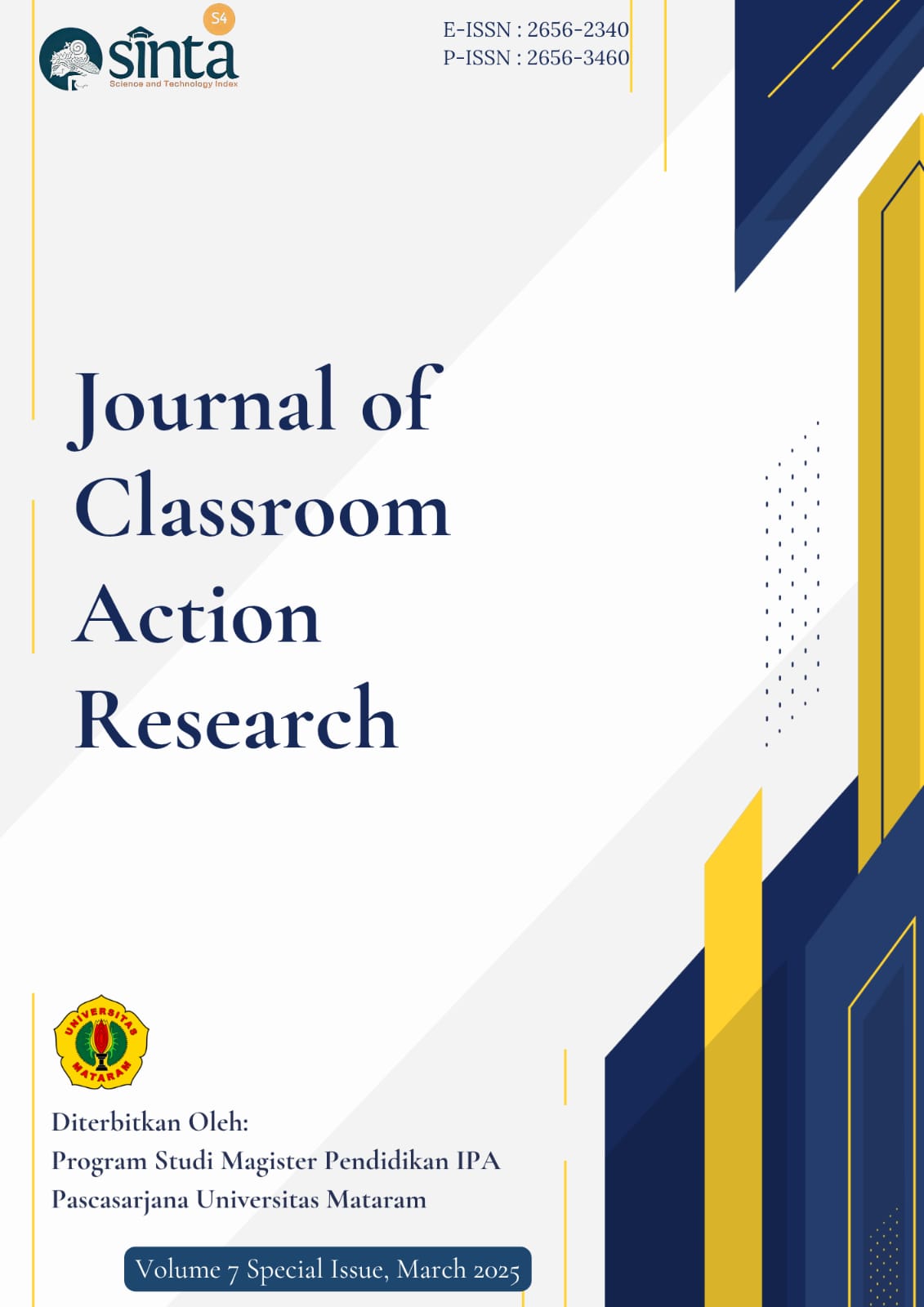
Improving Collaboration Skills, Critical Thinking, and Science Learning Achievement in Grade VII through Discovery Learning with TarL Approach
DOI:
10.29303/jcar.v7iSpecialIssue.9587Published:
2025-03-30Downloads
Abstract
Collaboration skills, critical thinking skills, and learning achievement are important for every student to have. However, the results of the researcher's observation in class VII D SMP N 4 Depok showed that collaboration skills, critical thinking, and science learning achievement were still low. Therefore, this study aims to analyze the improvement of collaboration skills, critical thinking skills, and learning achievement of students in class VII D SMP N 4 Depok after learning the Discovery Learning model with TarL approach on Earth and Solar System material. This research is a classroom action research (PTK) model of Kemmis & Mc Taggart with two cycles consisting of four stages, namely planning, action, observation, and reflection in each cycle. The subjects in this study were students of class VII D SMP N 4 Depok. Data collection techniques used observation, questionnaires, tests, and documentation. Data analysis of questionnaire and test results used descriptive statistics and n-gain test. The results obtained showed that there was an increase in cycle 1 to cycle 2 in the medium category, namely 1) collaboration skills with N Gain 0.413; 2) critical thinking skills with N Gain 0.413. Critical thinking ability with N Gain 0.474; 3) Learning achievement with N Gain 0.532. Thus, the application of Discovery Learning with TarL Approach is effective to improve collaboration skills, critical thinking skills, and learning achievement.
Keywords:
Discovery Learning TaRL Approach Collaboration Skills Critical Thinking Skills Science Learning AchievementReferences
Afdilla, A. N., Rednoningsih, T., & Sukaesih, S. (2024). Peningkatan Keterampilan Kolaborasi Melalui Model Discovery Learning pada pembelajaran IPA Kelas VIII B SMP Negeri 4 Semarang. Prosiding Seminar Nasional Pendidikan dan Penelitian Tindakan Kelas, 99–111.
Afikah, A., Astuti, S. R. D., Suyanta, S., Jumadi, J., & Rohaeti, E. (2022). Mobile Learning in Science Education to Improve Higher-Order Thinking Skills (HOTS) and Communication Skills: A Systematic Review. International Journal of Advanced Computer Science and Applications, 13(7), 698–704. https://doi.org/10.14569/IJACSA.2022.0130782
Aprianingsih, A., Ermiana, I., & Rahmatih, A. N. (2023). Pengaruh Model Discovery Learning Terhadap Kemampuan Berpikir Kritis IPA Siswa. Journal of Classroom Action Research, 5(3), 118–124. https://doi.org/https://doi.org/10.29303/jcar.v5i3.5153
Arfani, S., Yunus, S. R., & Umar, B. (2023). Penerapan Model Pembelajaran Discovery Learning dan Pendekatan Teaching At The Right Level (TaRL) Untuk Meningkatkan Motivasi Belajar IPA Peserta Didik Kelas VIII di SMP Negeri 1 Pamboang. JURNAL PEMIKIRAN DAN PENGEMBANGAN PEMBELAJARAN, 5(3), 21–31. https://doi.org/https://doi.org/10.31970/pendidikan.v5i3.855
Arikunto. (2015). Prosedur Penelitian Suatu Pendekatan Praktik. Rineka Cipta.
Aryanti, N. (2024). The Effect of Applying the Teaching at the Right Level (TaRL) Approach Assisted by LKPD to Improve the Learning Outcomes of Grade 6 Elementary School Students on Electrical Circuits. Jurnal Penelitian Pendidikan IPA, 10(7), 3664–3673. https://doi.org/https://doi.org/10.29303/jppipa.v10i7.7671
Barus, E. M., sari Ritonga, I., & Siregar, C. D. (2018). Hubungan Konsep Diri Dengan Kemampuan Berpikir Kritis Siswa Kelas X Mia Pada Mata Pelajaran Biologi Program Lintas Minat. JIFI (Jurnal Ilmiah Farmasi Imelda), 2(1), 11–14. https://doi.org/https://doi.org/10.52943/jifarmasi.v2i1.189
Chang, W. L., & Benson, V. (2020). Jigsaw teaching method for collaboration on cloud platforms. Innovations in Education and Teaching International. https://doi.org/10.1080/14703297.2020.1792332
Chopra, S., & Kauts, A. (2023). Development of Collaborative Skills Scale: Reliability and Validity. MIER Journal of Educational Studies Trends and Practices, 81–97. https://doi.org/https://doi.org/10.52634/mier/2023/v13/i1/2376
Chusni, M. M., Saputro, S., & Rahardjo, S. B. (2021). Student’s Critical Thinking Skills through Discovery Learning Model Using E-Learning on Environmental Change Subject Matter. European Journal of Educational Research, 10(3), 1123–1135. https://doi.org/https://doi.org/10.12973/eu-jer.10.3.1123
Chusni, M. M., Saputro, S., & Rahardjo, S. B. (2022). Enhancing Critical Thinking Skills of Junior High School Students Through Discovery-Based Multiple Representations Learning Model. International Journal of Instruction, 15(1), 927–945. https://doi.org/https://doi.org/10.29333/iji.2022.15153a
Danial, M., & Amin, F. (2024). Penerapan Model Discovery Learning Terintegrasi TaRL untuk Meningkatkan Hasil Belajar IPA Peserta Didik Kelas VII-4 UPT SPF SMP Negeri 2 Makassar. JURNAL PEMIKIRAN DAN PENGEMBANGAN PEMBELAJARAN, 6(2), 1560–1566. https://doi.org/https://doi.org/10.31970/pendidikan.v6i2.1280
Ennis, R. H. (1987). Critical Thinking and The Curriculum. Thinking skills instruction: Concepts and techniques, 40–48.
Fadillah, D. F., Suryani, D. I., & Taufik, A. N. (2023). Development of Higher Order Thinking Skill Test Instrument in Packaged Foods Topic to Enhance Critical Thinking Ability of Junior High School Students. Jurnal Pijar Mipa, 18(4), 546–554. https://doi.org/https://doi.org/10.29303/jpm.v18i4.4967
Greenstein, L. M. (2012). Assessing 21st Century Skills: A Guide to Evaluating Mastery and Authentic Learning. Corwin Press.
Gulo, A. (2022). Penerapan Model Discovery Learning terhadap Hasil Belajar Peserta Didik pada Materi Ekosistem. Educativo: Jurnal Pendidikan, 1(1), 307–313. https://doi.org/https://doi.org/10.56248/educativo.v1i1.54
Haber, J. (2020). Critical Thinking. MIT Press.
Hake, R. R. (1999). Analyzing Change/Gain Scores. Dept of Physics Indiana University.
Hasanah, M., Muis, A., & Alim, M. H. (2024). Penerapan Model Discovery Learning berbasis Tarl untuk Meningkatkan Kemampuan Berpikir Tingkat Tinggi Siswa. JURNAL PEMIKIRAN DAN PENGEMBANGAN PEMBELAJARAN, 6(2), 191–199. https://doi.org/https://doi.org/10.31970/pendidikan.v6i2.1049
Iskandar, N. A., Krismanto, W., & Lukman, L. (2024). Fostering Critical Thinking Skills in Elementary Schools with Video-Assisted Discovery Learning. Journal of Classroom Action Research, 6(2), 252–260. https://doi.org/https://doi.org/10.29303/jcar.v6i2.5227
Kusumastuti, I., Anggraeni, S., & Surakusumah, W. (2020). Penerapan Asesmen Kinerja dalam Meningkatkan Kemampuan Inkuiri melalui Pembelajaran Levels of Inquiry Siswa SMA. Syntax Literate, 5(1), 101–116.
Makhmudah, S., Irawati, M. H., & Sueb, S. (2021). Pengembangan Lembar Kerja Siswa (LKS) Berbasis Model Discovery Learning Dipadu Think Pair Share Dan Pengaruhnya Terhadap Kemampuan Berpikir Kritis Serta Hasil Belajar Kognitif Siswa. Jurnal MIPA dan Pembelajarannya (JMIPAP), 1(1), 79–87.
Marhamah, M., Maimunah, M., Amin, K., & Misnawati, M. (2023). Practicing 21st Century Skills for SMPN 1 Aikmel Students through A Scientific Approach with a Lesson Study Model. Bioedukasi: Jurnal Pendidikan Biologi, 16(1), 38–42. https://doi.org/https://doi.org/10.20961/bioedukasi-uns.v16i1.70335
Muaffiani, A., Artayasa, I. P., & Merta, I. W. (2022). Pengaruh Penerapan Pembelajaran Berbasis Kasus pada Materi Zat Aditif dan Adiktif Terhadap Keterampilan Berpikir Kritis Siswa. Journal Of Classroom Action Research, 4(3), 120–126. https://doi.org/https://doi.org/10.29303/jcar.v4i3.1967
Nor, H. M., & Sihes, A. J. (2021). Critical ThinkingSskills in Education: A Systematic Literature Review. International Journal of Academic Research in Business and Social Sciences, 11(11), 198–201. https://doi.org/http://dx.doi.org/10.6007/IJARBSS/v11-i11/11529
Nusantari, E., Abdul, A., Damopolii, I., Alghafri, A. S. R., & Bakkar, B. S. (2021). Combination of Discovery Learning and Metacognitive Knowledge Strategy to Enhance Students’ Critical Thinking Skills. European Journal of Educational Research, 10(4), 1781–1791. https://doi.org/https://doi.org/10.12973/eu-jer.#10.4.1781
Pettersson, F. (2021). Understanding Digitalization and Educational Change in School by Means of Activity Theory and The Levels of Learning Concept. Education and Information Technologies, 26(1), 187–204. https://doi.org/https://doi.org/10.1007/s10639-020-10239-8
Putri, R. S., Hendri, M., & Rasmi, D. P. (2023). The Analysis of Implementing STEM-based LKPD to Enhance Students’ Collaboration Skills in School. Jurnal Pendidikan Fisika dan Teknologi, 9(1), 109–114. https://doi.org/https://doi.org/10.29303/jpft.v9i1.4825
Rahmadhani, P., & Ardi, A. (2024). Studi literatur: Pengaruh Model Pembelajaan Project Based Learning (PjBL) Terhadap Keterampilan Kolaborasi Peserta Didik. Jurnal Pendidikan Tambusai, 8(1), 5153–5162.
Rahman, A. (2023). Meningkatkan Hasil Belajar Shooting Bola Basket Melalui Metode Pembelajaran Teaching At The Right Level (Tarl) Pada Siswa Kelas X-3 SMAN 3 Jombang Tahun Pelajaran 2022-2023. Journal On Education, 6(1), 2036–2043. https://doi.org/https://doi.org/10.31004/joe.v6i1.3186
Rosnidar, R., Yusrizal, Y., Mustafa, M., & Susanna, S. (2021). Application of Discovery Learning Model in Increasing Student Interest and Learning Outcomes. Jurnal Penelitian Pendidikan IPA, 7(4), 542–548. https://doi.org/https://doi.org/10.29303/jppipa.v7i4.745
Safitri, W. C. D., & Mediatati, N. (2021). Penerapan Model Discovery Learning dalam Pembelajaran IPA untuk Meningkatkan Kemampuan Berpikir Kritis dan Hasil Belajar Siswa Sekolah Dasar. Jurnal Basicedu, 5(3), 1321–1328. https://doi.org/https://doi.org/10.31004/basicedu.v5i3.925
Saputra, M. D., Joyoatmojo, S., Wardani, D. K., & Sangka, K. B. (2019). Developing Critical-Thinking Skills through The Collaboration of Jigsaw Model with Problem-Based Learning Model. International Journal of Instruction, 12(1), 1077–1094.
Sari, W., & Tahir, S. (2024). Peningkatan Keterampilan Kolaborasi Melalui Model Discovery Learning Pada Peserta Didik Kelas VII. I UPTD SMP Negeri 1 Pallangga. JURNAL PEMIKIRAN DAN PENGEMBANGAN PEMBELAJARAN, 6(2), 135–143. https://doi.org/https://doi.org/10.31970/pendidikan.v6i2.1033
Sarwanto, S., Fajari, L. E. W., & Chumdari, C. (2021). Critical Thinking Skills and Their Impacts on Elementary School Students. Malaysian Journal of Learning and Instruction, 18(2), 161. https://doi.org/https://doi.org/10.32890/mjli2021.18.2.6
Shanta, S., & Wells, J. G. (2022). T/E Design Based Learning: Assessing Student Critical Thinking And Problem Solving Abilities. International Journal of Technology and Design Education, 32(1), 267–285. https://doi.org/https://doi.org/10.1007/s10798-020-09608-8
Shimizu, I., Matsuyama, Y., Duvivier, R., & van der Vleuten, C. (2022). Perceived Positive Social Interdependence in Online Versus Face-to-Face Team-Based Learning Styles of Collaborative Learning: A Randomized, Controlled, Mixed-Methods Study. BMC Medical Education, 22(1), 567. https://doi.org/https://doi.org/10.1186/s12909-022-03633-y
Sitompul, N. A., Anas, N., & Siregar, L. N. K. (2023). Pengembangan LKPD Berbasis Discovery Learning pada Materi Ekosistem untuk Meningkatkan HOTS Siswa Kelas X SMA. Spizaetus: Jurnal Biologi dan Pendidikan Biologi, 4(3), 243–260.
Sotto Jr, R. (2021). Collaborative Learning In The 21st Century Teaching And Learning Landscape: Effects To Student’s Cognitive, Affective And Psychomotor Dimensions. International Journal of Educational Management & Innovation, 2(2). https://doi.org/https://doi.org/10.12928/ijemi.v2i2.3325
Susilawati, E., Agustinasari, A., Samsudin, A., & Siahaan, P. (2020). Analisis Tingkat Keterampilan Berpikir Kritis Siswa SMA. Jurnal Pendidikan Fisika Dan Teknologi, 6(1), 11–16. https://doi.org/http://dx.doi.org/10.29303/jpft.v6i1.1453
Tang, T., Vezzani, V., & Eriksson, V. (2020). Developing critical thinking, collective creativity skills and problem solving through playful design jams. Thinking Skills and Creativity, 37(May), 100696. https://doi.org/10.1016/j.tsc.2020.100696
Usman, M., Degeng, I. N. S., Utaya, S., & Kuswandi, D. (2022). The Influence of JIGSAW Learning Model and Discovery Learning on Learning Discipline and Learning Outcomes. Pegem Journal of Education and Instruction, 12(2), 166–178. https://doi.org/10.47750/pegegog.12.02.17
Utami, A. F., Danial, M., & Rahman, Y. (2024). Penerapan Model Discovery Learning dengan Pendekatan Teaching at The Right Level (TaRL) untuk Meningkatkan Hasil Belajar Peserta Didik Kelas VIII SMPN 2 Makassar. JURNAL PEMIKIRAN DAN PENGEMBANGAN PEMBELAJARAN, 6(2), 1318–1323. https://doi.org/https://doi.org/10.31970/pendidikan.v6i2.1253
Warsah, I., Morganna, R., Uyun, M., Afandi, M., & Hamengkubuwono, H. (2021). The Impact of Collaborative Learning on Learners’ Critical Thinking Skills. International Journal of Instruction, 14(2), 443–460.
Zajda, J., & Zajda, J. (2021). Constructivist Learning Theory and Creating Effective Learning Environments. Globalisation and education reforms: Creating effective learning environments, 35–50. https://doi.org/https://doi.org/10.1007/978-3-030-71575-5_3
License
Copyright (c) 2025 Laifa Rahmawati, Latief Susila Aji, Hasna Irfantiningtyas Sari, Hadi Eko Prasetio, Fuji Hutami Ningsih, Ismi Dian Khairunnisa Harlena, Fadhilah Nur Laila, Feby Permata Sari, Allesius Maryanto

This work is licensed under a Creative Commons Attribution 4.0 International License.
- Authors who publish with Journal of Classroom Action Research, agree to the following terms:
- Authors retain copyright and grant the journal right of first publication with the work simultaneously licensed under a Creative Commons Attribution 4.0 International License (CC-BY License). This license allows authors to use all articles, data sets, graphics, and appendices in data mining applications, search engines, web sites, blogs, and other platforms by providing an appropriate reference. The journal allows the author(s) to hold the copyright without restrictions and will retain publishing rights without restrictions.
- Authors are able to enter into separate, additional contractual arrangements for the non-exclusive distribution of the journal's published version of the work (e.g., post it to an institutional repository or publish it in a book), with an acknowledgment of its initial publication in Journal of Classroom Action Research.
- Authors are permitted and encouraged to post their work online (e.g., in institutional repositories or on their website) prior to and during the submission process, as it can lead to productive exchanges, as well as earlier and greater citation of published work (See The Effect of Open Access).